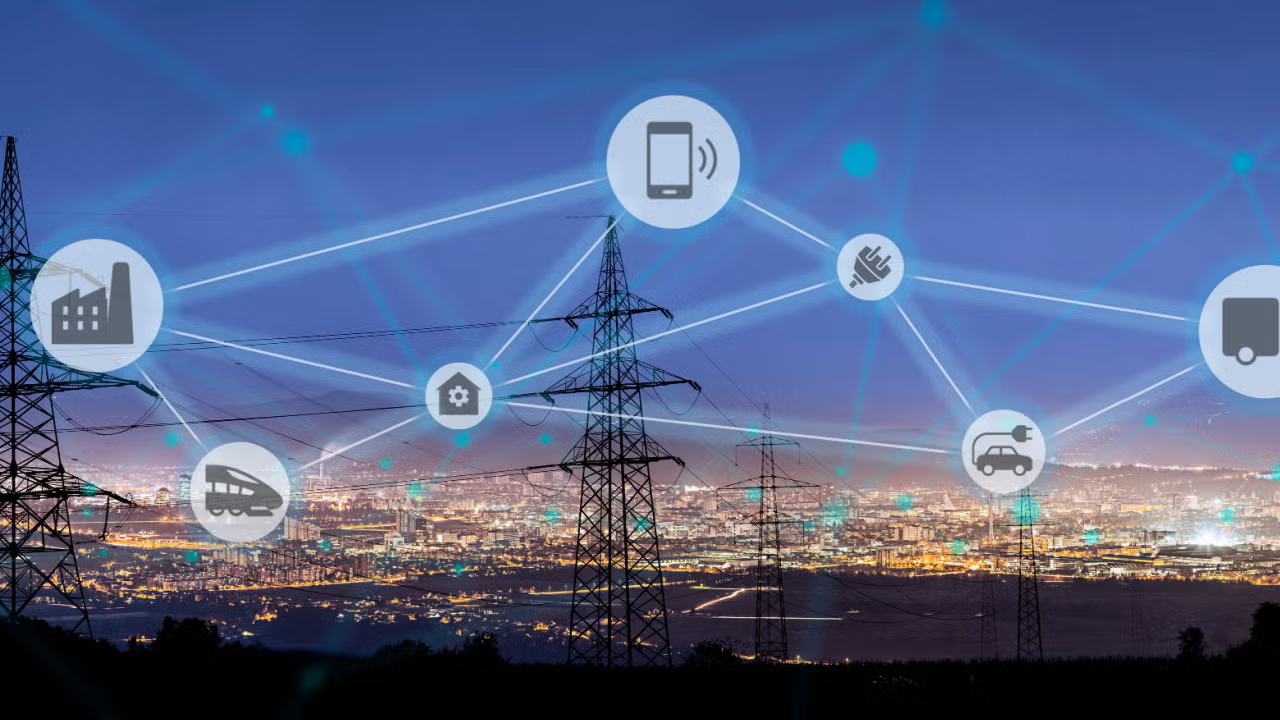
Smart Grid Networking: A Definitive Guide to the Future of Energy
Smart grid networking the traditional electrical grid is arguably the most complex machine ever built, yet for most of its history, it has operated as a one-way street. Electricity was generated at large, centralized power plants and pushed toward passive consumers through a rigid network of copper and steel. This nineteenth-century architecture is currently buckling under the weight of twenty-first-century demands: the intermittency of renewables, the massive load of electric vehicle (EV) charging, and the volatility of extreme weather events. The solution to this systemic fragility is not merely more wires, but more intelligence.
The transition toward a digitized energy landscape is fundamentally a networking challenge. At the heart of this transformation is the convergence of power engineering and information technology. We are moving toward a system where every transformer, solar inverter, and smart appliance acts as a node in a vast, distributed data network. This shift allows for bidirectional flow—not just of electrons, but of information—enabling a grid that is self-healing, adaptive, and capable of balancing supply and demand in real-time.
However, the implementation of smart grid networking is fraught with technical friction and legacy constraints. It requires the integration of diverse communication protocols, from long-range cellular and satellite links to localized mesh networks, all while maintaining the “five-nines” (99.999%) reliability expected of critical infrastructure. The complexity lies in managing millions of end-points without introducing catastrophic cybersecurity vulnerabilities or overwhelming the system with data noise.
This article serves as a definitive exploration of the architectural layers, strategic frameworks, and risk taxonomies associated with modern grid networking. It moves beyond the high-level concept of “smart meters” to analyze the deep-tissue engineering required to build a resilient, decentralized energy internet. We will examine the mechanics of how data-driven power distribution functions, the economic realities of large-scale deployment, and the long-term governance needed to ensure these systems remain stable for decades to come.
Understanding “smart grid networking”

To define smart grid networking accurately, one must view it as the nervous system of the power grid. It is the multi-layered communication infrastructure that allows utilities and consumers to interact with the physical flow of electricity. Unlike the “dumb” grid, which relies on manual intervention and forensic analysis after a failure, a networked smart grid uses sensor fusion and high-speed data backhaul to predict and mitigate issues before they result in outages.
A primary oversimplification in public discourse is the idea that the “smart meter” is the sum total of the network. In reality, the meter is merely an edge device. The true intelligence resides in the middle-mile and back-office systems: the Advanced Metering Infrastructure (AMI), the Distribution Management Systems (DMS), and the Wide Area Monitoring Systems (WAMS). These systems process telemetry from the edge to perform tasks like “Volt-VAR optimization,” which reduces energy loss by fine-tuning voltage levels across the network.
Common misunderstandings also ignore the “latency requirements” of grid data. Information in this network is not monolithic. Billing data can have a latency of hours, but “protection and control” data—the signals that tell a circuit breaker to trip to prevent a fire—must move in milliseconds. Smart grid networking must therefore prioritize traffic through “network slicing” or dedicated private frequencies (seismic, RF, or cellular) to ensure that critical safety signals are never stuck behind a routine software update or consumer data packet.
Evolutionary Context: From Analog to Algorithmic
Smart grid networking the grid has evolved through three distinct phases. The Electromechanical Era (1880s–1970s) was defined by analog controls and human operators. If a tree fell on a line, the utility only knew when customers called to complain. The Digital Transition Era (1980s–2000s) introduced SCADA (Supervisory Control and Data Acquisition) systems, which brought visibility to high-voltage transmission lines but left the lower-voltage “distribution” network (the wires in your neighborhood) largely in the dark.
We have now entered the Distributed Intelligence Era. This phase is characterized by the explosion of Distributed Energy Resources (DERs), such as residential solar and battery storage. The grid is no longer a hierarchy; it is a peer-to-peer network. Networking in this era must handle “bidirectional power flow,” where a home can be a consumer in the morning and a generator in the afternoon. This requires an unprecedented level of coordination to prevent voltage spikes and equipment damage.
Conceptual Frameworks and Mental Models Smart Grid Networking
To navigate the complexity of grid networking, engineers and planners utilize specific mental models:
-
The Edge-to-Core Hierarchy: This model segments the network into layers: the Home Area Network (HAN), the Neighborhood Area Network (NAN), the Field Area Network (FAN), and the Wide Area Network (WAN). Each layer has different bandwidth, power, and security requirements.
-
The Microgrid Fractal Model: This framework views the grid as a collection of smaller, semi-autonomous cells (microgrids). Each cell can “island” itself—disconnect from the main grid during a failure—and operate independently using local generation. Networking here focuses on the “handshake” protocols required to reconnect to the main grid safely.
-
The Virtual Power Plant (VPP) Framework: This treats thousands of individual batteries and EVs as a single, large power plant. The networking challenge is “orchestration”—sending a signal to 10,000 devices to discharge simultaneously to prevent a blackout, requiring perfect synchronization.
Infrastructure Categories and Technical Variations
The choice of communication technology involves significant trade-offs between range, cost, and reliability.
Decision Logic: Selecting the Backhaul
For dense urban environments, RF Mesh is often the gold standard because the proximity of houses allows for a robust, redundant network. In contrast, rural cooperatives often rely on Cellular or Satellite because the cost of laying fiber or building mesh repeaters across miles of farmland is prohibitive.
Detailed Real-World Scenarios Smart Grid Networking
Scenario A: The “EV Morning Surge”
A neighborhood has 50 new EVs all programmed to charge at 8:00 AM.
-
Network Action: The smart grid detects the surge in local transformer load via the NAN. It sends an “orchestration signal” to the chargers to stagger the start times by 5–10 minutes.
-
Failure Mode: If the networking fails, the transformer blows due to thermal overload, leading to a localized blackout even though the main grid has plenty of power.
Scenario B: The Self-Healing Recloser
A storm causes a branch to momentarily touch a line, creating a “fault.”
-
Network Action: Intelligent electronic devices (IEDs) sense the fault and communicate at sub-second speeds. They isolate the specific segment of the line and reroute power through an adjacent circuit.
-
Second-order Effect: Customers experience a “flicker” rather than a four-hour outage. The network logs the exact GPS coordinates of the fault for a maintenance crew to inspect.
Planning, Economics, and Resource Dynamics Smart Grid Networking
The transition to a smart grid is a multi-billion dollar capital intensive project. The primary challenge for utilities is the “stranded asset” risk—investing in a networking technology that becomes obsolete before the 20-year depreciation cycle ends.
The opportunity cost of failing to network the grid is increasingly high. Utilities that do not invest in smart grid networking face higher O&M (Operations and Maintenance) costs because they must roll trucks for manual inspections and rely on expensive “peaker plants” rather than demand-side management.
Risk Taxonomy and Compounding Failures
Networked infrastructure introduces new categories of risk that did not exist in the analog era.
-
Cyber-Physical Cascades: A hacker doesn’t just steal data; they gain the ability to physically open circuit breakers. If multiple breakers are opened in a specific sequence, it can cause “frequency instability” that collapses the entire regional grid.
-
GPS Dependency: Many smart grid devices rely on GPS for precise time-stamping (synchrophasors). GPS jamming or spoofing can blind the network’s ability to synchronize the phase of electricity, making it impossible to merge microgrids or transmission lines.
-
Communication Congestion: During a major storm, millions of devices might try to report “Power Out” at the same time, creating a “broadcast storm” that crashes the very network needed to manage the recovery.
Governance and Long-Term Adaptation Smart Grid Networking
A networked grid requires a transition from “Commodity Governance” to “Platform Governance.”
-
The Interoperability Audit: Ensuring that a meter from Vendor A can talk to a software platform from Vendor B. This is largely driven by standards like IEEE 2030.5.
-
The “Zero Trust” Architecture: Moving away from the idea that the “internal” utility network is safe. Every device must be authenticated and every command encrypted.
-
Dynamic Review Cycles: Unlike a bridge or a dam, the software and security layers of the grid must be updated quarterly to address emerging threats.
Measurement, Tracking, and Evaluation
How do we measure the “intelligence” of a network?
-
Leading Indicators: Latency of protection signals, percentage of the distribution network with real-time visibility, and the “security patch” rate of field devices.
-
Lagging Indicators: SAIDI (System Average Interruption Duration Index) and SAIFI (System Average Interruption Frequency Index). A successful network shows a steady decline in these numbers despite increasing weather volatility.
Common Misconceptions Smart Grid Networking
-
Myth: Smart grids are primarily about saving the consumer $10 a month. Correction: They are primarily about preventing catastrophic systemic failure and enabling the decarbonization of the economy.
-
Myth: Wireless signals from smart meters are a health risk. Correction: A smart meter typically transmits for less than one minute per day and operates at power levels far lower than a standard smartphone.
-
Myth: The grid is already “smart” because we have computers in the head office. Correction: Visibility in the head office is useless if there is no “actuation” at the neighborhood level to respond to real-time changes.
Conclusion
The implementation of smart grid networking is the definitive engineering challenge of the mid-century. We are rebuilding the world’s largest machine while it is still running, moving from a rigid, centralized model to a fluid, decentralized ecosystem. This requires a profound shift in how we value energy—not just as a commodity, but as a service that depends on a robust, secure, and ultra-low-latency data network. The success of this transition will determine our ability to integrate renewables, survive extreme climate events, and maintain the reliable energy foundation upon which modern civilization is built. The “Smart” in the smart grid isn’t about the hardware; it’s about the connections between them.